Data source is Linda Gunsaulies Tiederman. email tiedermanL@yahoo.com
1940: Springfield, Clark, Ohio
Elly Mumma 31, salesman of meats
Thelma Mumma 28
Carrell Lee Mumma 1
SSDI - EDDY MUMMA 14 Jul 1908 - Sep 1986, died Gainesville, Alachua, FL, SS# 281-09-1714 Ohio
An interesting story about Eddy Mumma as related by Lenny Kesl/a>
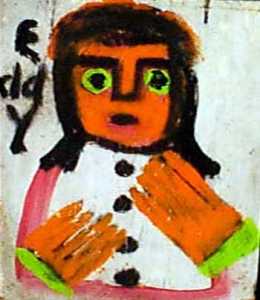
Samples of Eddy's Art
http://southernfolkartmagazine.com/EddyMumma/EddyMumma.htm">http://southernfolkartmagazine.com/EddyMumma/EddyMumma.htm
***********************************************************************
http://americaohyes.com/pages/mumma.htm
EDWARD "MR. EDDY" MUMMA
Mr. Eddy was born in Milton Ohio in 1908. He traveled around the country a lot, doing odd jobs until he married and settled on a small farm near Springfield, Ohio. Then he started an antiques and junk business. After his wife died he moved to Gainesville, Florida around 1966, to be closer to his daughter. Mr. Eddy suffered from diabetes, which eventually cost him both legs. He painted mostly round faced portraits of a man, though he occasionally did other images, including sailboats. He painted with acrylics on plywood or masonite. He would not sell his paintings. The day Mr. Eddy died in 1986 according to information in the Rosenak's "Folk Art Encyclopedia", a folk art collector happened by and arranged to buy between 600 and 800 of the artist's works. The family considered him an eccentric and had no use for his paintings. His work is in the permanent collection of the St. James Folk Art Museum. [see additional information provided by his daughter]
***********************************************************************
http://www.thebrogan.org/outsiderart/artist6.html
NOTE: The following biography has been edited and corrected by Eddy's daughter, Carroll Mumma Gunsaulies who is now deceased.
Ed "Mr. Eddy" Mumma
Gainesville, Florida
1908 -- 1986
Eddy Mumma, who liked to call himself "Mr. Eddy", was an artist who compulsively painted a single image. He was a self-sufficient man, proud and uncomplaining in the face of adversity. After finishing eighth grade, Mumma "rode the rails." He became a hobo, traveling the country and picking up whatever jobs a particular locality had to offer. When he married in 1936, he and his wife eventually settled on a small farm near Springfield, Ohio. In Springfield, Arthur Huebner, Thelma's father, was a co owner of Braun Brothers Packing Company. Eddy worked for Arthur until Arthur died. Then Eddy and Thelma moved to another house in Springfield. Eventually, they bought a farm in about 1942. Eddy was listed for the draft, even though he was 35 or 36, and bought the farm to escape going to war. He and Thelma had no previous farm experience, but learned by listening to the experienced farmers. The farm had giant goldfish, but they raised primarily hay and corn and sold milk from the cows on the farm. They moved to a second farm in 1946. It was much larger with two houses. Thelma's mother, Stella Huebner, lived on the property as well. They raised hay and corn and registered Angus Cattle Stock for breeding. As a hobby, the family collected antiques. They also managed some rental properties. Mumma continued farming for a while after his wife's death. Eddy did not do well after the death of his wife, Thelma, at age 44. He started drinking heavily, developed a tumor on the back of his head, and developed diabetes. He spent some time in a mental institution after being diagnosed with schizophrenia. He moved to Gainesville, Florida, in 1967 to be closer to his daughter. He bought two small houses there, living in one and renting out the other. Eddy Mumma suffered from diabetes. His left leg was amputated just above the knee in 1970, and his right leg followed in 1984.
In 1969 Mumma's daughter, Carroll, suggested to her father that he "get out of the house and take an art lesson." The class did not work out because the "instructor accused his pupil of being artistically sloppy," but from that day on, Mumma painted feverishly, filling every wall of his small home with his work. He sold very few paintings during his lifetime, even though he needed money desperately. "They belong here, where I can see them," he repeatedly declared.
Lenny Kesl, a Gainesville artist, discovered Mumma, befriended him, and supplied him with materials. "I offered to show his work at the college where I taught," he says, "but Mr. Eddy wouldn't take [his paintings] down off his walls." On the day Mumma died, a folk art collector happened to see the family gathering and, after inquiring into the circumstances, arranged on the spot to buy between six hundred and eight hundred of the artist's works. The family considered Mumma an eccentric and had little use for his paintings. His grandchildren did and still do appreciate the artwork of Eddy Mumma and have kept some of his work. Much of the artwork in the house was cockroach infested because he did not want anyone cleaning for him. His house was a sight to see because Eddy painted everything including the bedroom doors and the lamps.
Mumma repeatedly painted an abstract version of the bust of a round-faced man with his hands held against his chest, possibly a self-portrait. The face always looks straight ahead, without expression. It is a compulsive image, painted flat on a colorful background, and is both intriguing and compelling. The artist also did some landscapes and some animals, but he always returned to his full-faced man, often painting images on both sides of the board. Mumma painted on plywood or Masonite with acrylics. He was a colorist and did not hesitate to experiment with different shades of the same color in his paintings. He made some of his own frames from scraps of wood and plastic. Mumma completed close to one thousand paintings, most around 12 by 15 inches, but a few are larger.
***********************************************************************
[excerpt
http://xroads.virginia.edu/~DRBR2/wilson2.html)
SELF-TAUGHT ARTISTS: WHO THEY ARE
Alice Rae Allen
For formally tutored artists, evolution of style is a significant measure of artistic growth over time, to be analyzed in depth by the artist, friends, peers, critics, collectors, dealers, and museums. But the style of a selftaught artist may or may not substantially evolve. The work of Ed "Mr. Eddy" Mumma, "Uncle Jack" Dey, Benjamin F. Perkins, J. P. Scott, and George Williams, for example, has shown little stylistic development and change over time, whereas other artists such as Thornton Dial, Sr., William Hawkins, Howard Finster, and Jimmy Lee Sudduth demonstrate remarkable evolution., Regardless of growth, diversity, or similarity, stylistic development is not an issue of concern to the self-taught artist.